
Variable and Supersonic Winds in the Atmosphere of an Ultrahot Giant Planet
by Silva Järvinen on 2022-04-05
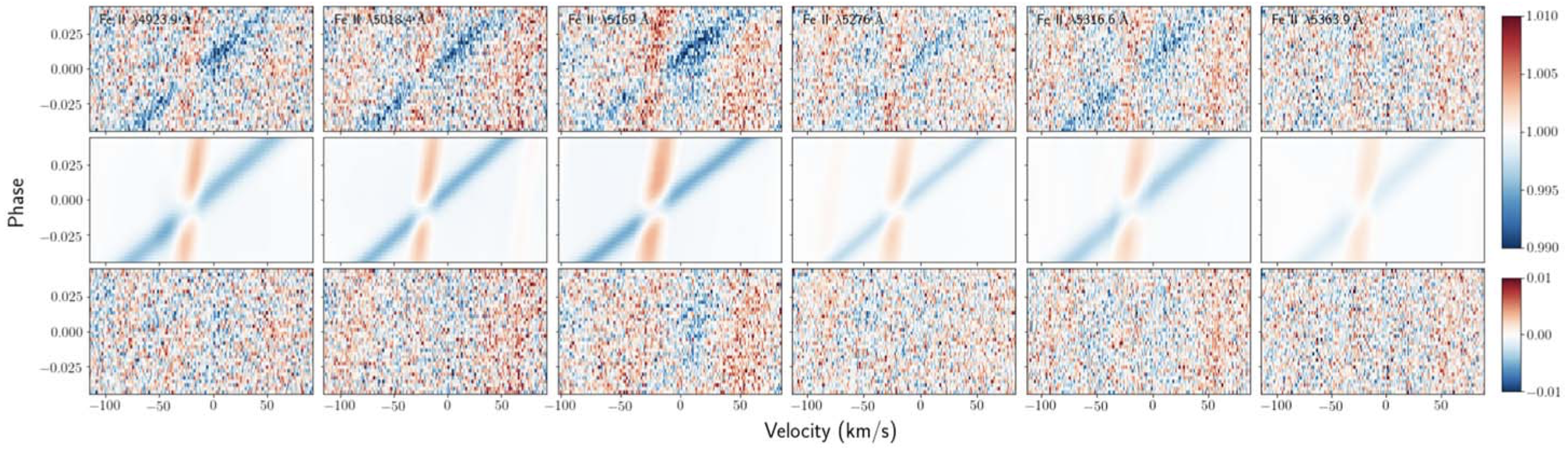
Hot Jupiters receive intense irradiation from their stellar hosts. The resulting extreme environments in their atmospheres allow us to study the conditions that drive planetary atmospheric dynamics, e.g., global-scale winds. General circulation models predict day-to-nightside winds and equatorial jets with speeds of the order of a few km s-1. To test these models, we apply high-resolution transmission spectroscopy using the Potsdam Echelle Polarimetric and Spectroscopic Instrument (PEPSI) spectrograph on the Large Binocular Telescope to study the atmosphere of KELT-9 b, an ultrahot Jupiter and currently the hottest known planet. We measure ~10 km s-1 day-to-nightside winds traced by Fe II features in the planet's atmosphere. This is at odds with previous literature (including data taken with PEPSI), which report no significant day-to-nightside winds on KELT-9 b. We identify the cause of this discrepancy as due to an inaccurate ephemeris for KELT-9 b in previous literature.
Read more: Pai Asnodkar et al. 2022, AJ, 163, 155